
Doctoring the Office: EU alternatives to SaaS platforms
As a small creative business with growth ambitions, this year we decided to face the elephant in the room, or rather, the SaaS giants, who were definitely in the room with us. Bootstrapping our business in 2022/23, we were two co-founders, two workstations and a domain name. Our software choices on the infrastructure side were driven by speed of access, convenience and price per seat. Like many SMEs, XYZ Technical Art Services went with a cloud provider on the other side of the Alphabet until further notice.
Add to that subscriptions to other tools such as whiteboards and task boards, plus the various cloud services used by collaboration partners, we quickly ended up with a lot of information in different places:
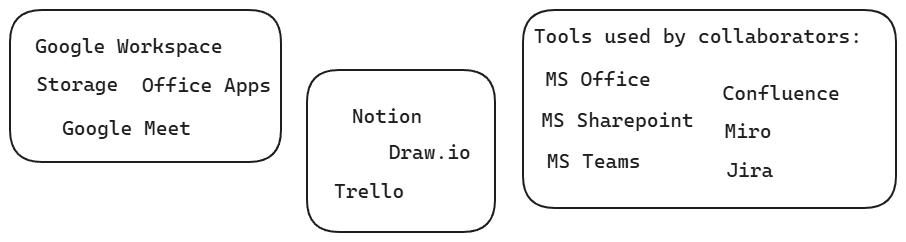
Notice duly arrived when we began working with EU-funded projects in the cultural heritage sector, which demanded a high level of transparency and adherence to FAIR data and open science principles. Together with the increase in prices per seat for many cloud services to pay for all the additional AI features we did not have much use for, we had enough motivation to consider a migration to EU-based servers and software. Late 2025 and early 2026 was our planned window for implementation. Any later, and we would have had a lot more material to migrate, which would have made the process a lot more painful.
In summary, our main reasons to switch were:
– European values (ours and our clients’, such as GDPR compliance and digital sovereignty)
– Freedom to grow without overwhelming license fees
– Being able to host collaborative projects in a unified workspace
– Building in-house backend expertise for research and innovation projects
What did we need?
Disclaimer: Every business has its own reasons and requirements for switching from their currently tolerated stack, so this is strictly a CASE STUDY, not a set of recommendations!
Our requirement was an all-in-one cloud infrastructure with storage, collaborative applications, compliant security and mail hosting that we could host on managed servers while keeping our web domain. Since our in-house sysadmin was going to be responsible for the implementation, a good support structure and active community was also important.
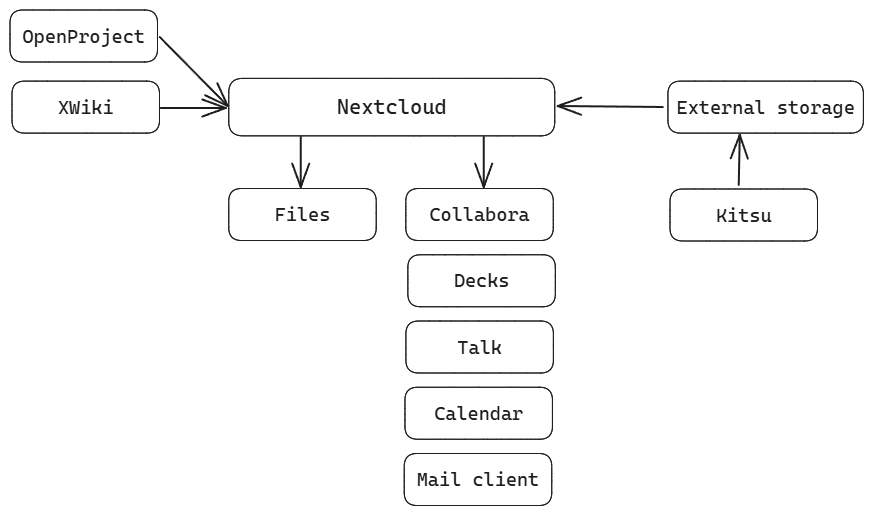
Our first port of call was European Alternatives to discover potential replacements of the tools we were currently using most. We landed on the decision to use Nextcloud as a hub, with their applications and integrations providing the functionality we needed: Office apps, project management software integration for OpenProject and XWiki, and cloud storage with additional space for our industry-specific version control and project management applications.
While Nextcloud, as well as OpenProject and XWiki have enterprise level per-seat pricing for cloud services, we wanted to deploy our own instance on a server from an EU provider who uses green energy and allows use of space at several locations to ensure that best practices of storage and data preservation could be adhered to.
Migration process
Facing the process of migrating our files and other data really forced us to take stock of our filing system. A saving grace was the fact that we organise our storage and archive a lot like a VFX house, with a clear separation between files in use for live projects, libraries, archives and cold storage (files we have to keep long-term for compliance purposes). This meant that we could migrate the bulk without disrupting day-to-day business to the new cloud storage, while still using our old infrastructure.
The next step was to add collaboration apps to the Nextcloud hub to facilitate daily operation, and therefore migration of live projects and day-to-day management.
The most valuable Nextcloud applications we use are
– Talk (chat and video calls)
– Whiteboard (interactive collaborative board and diagramming)
– Collabora (Documents, presentations and spreadsheets)
– Decks (Task board)
For project management and documentation, we integrated instances of OpenProject and XWiki.
With all this comes the need for account and permissions management, which is handled through Nextcloud’s admin settings.
Running a stack/infrastructure such as this needs securing. We reference Information Security Management best practices and align with standards such as ISO 27001, which means running regular security audits, malware scans, securing firewalls and even good old air gaps where possible.
Email infrastructure is not something we wanted to self-host, so we are using a reliable EU-based, GDPR compliant service.
Bottom line
For us, migrating from US-based cloud services means that we are now fully aligned with EU digital strategies, which is important for our participation in publicly funded projects. By running our own instance of Nextcloud and its applications, we can decide which features we need, without being forced to pay for something we do not want. It will also allow us to grow the team and ramp up depending on workload without being overwhelmed by monthly license fees.
As a small creative studio, we had some prior experience with implementing Kitsu and Apache SVN as version control. Implementing our new cloud infrastructure was quite a bit less complicated, so if your studio has similar backend experience, it is worth looking into a migration to EU-based open-source software.